Birdwatching mindfulness: 6 practices that steady attention in recovery
 Save
Birdwatching builds two skills gambling recovery depends on: attention that stays on one thing, and patience with what you cannot control. Watching for a wren in winter scrub or a kestrel over grassland teaches you to notice small movements, wait without forcing an outcome, and accept that some days bring sightings and others do not. Below you will find six ways to use wildlife observation as a mindfulness practice, plus what you need to start and where to go for support if urges to gamble return.
Whitley Wildlife covers nature activities that support emotional wellbeing during recovery from gambling harm.
Slowing your scan rate
Birdwatching asks you to slow down how quickly your eyes move. A robin flicking through leaf litter, a coal tit working a pine cone — each needs you to hold your gaze steady rather than flicking to the next branch or the next hedge. That steadiness is the opposite of the rapid scanning gambling encourages, where each spin or each result pulls your attention forward before the last one has settled.
Start by picking one tree, hedge or patch of water and watching it for two minutes without moving your eyes to another area. Let birds enter your field of view rather than chasing them. If your attention drifts to what happened yesterday or what you need to do later, bring it back to the movement in front of you. The skill transfers: when an urge to gamble arrives, you have practised holding your attention on what is here rather than what might happen next.
Choosing a single species
On days when your mind will not settle, choose one species and look only for that. Blackbirds are common enough that you will find them in most parks and gardens; goldfinches gather on teasels and thistles in scrubby ground. Searching for one bird gives your attention a specific task and reduces the overwhelm of trying to notice everything at once.
Waiting without rushing the outcome
Birds do not perform on demand. You might stand by a hedge for ten minutes and see nothing, then a dunnock appears for three seconds and vanishes. Birdwatching teaches you to value the waiting as much as the sighting, because the waiting is where the steadying happens. Gambling collapses waiting into urgency — each moment is only worth something if it brings a result. Wildlife observation reverses that.
Try this: go to the same spot three days in a row at the same time and watch for ten minutes. Do not count sightings or measure success by how many species you see. Notice instead how your body feels after ten minutes of standing still, how your breathing changes, whether the static position lets tension leave your shoulders. The practice is the waiting, not what the waiting produces.
Listening before looking
Most bird activity you hear before you see. A wren's rattle in undergrowth, a blackbird's alarm call, the thin contact notes of long-tailed tits moving through a hedge — sound gives you notice that something is near. Training your ear to pick out calls from background noise builds the kind of focused listening that helps when urges arrive: you hear the urge earlier, recognise its shape, and respond before it intensifies.
Stand still in a park or woodland edge and close your eyes for one minute. Count how many different bird sounds you can hear. Open your eyes and try to locate the birds making them. Repeat the exercise each visit. Over weeks you will recognise calls without thinking, and your attention will settle faster because your ear does part of the work your eyes used to do alone.
Recording what you hear
Keep a small notebook and jot down the calls you heard, even if you cannot name the species yet. "Sharp chip from the top of the oak" or "repeated whistle from the rooftop" — the act of translating sound into words anchors your attention and gives you something to look up later. The notes are not for anyone else; they are proof to yourself that you stayed present.
Accepting days without sightings
Some mornings you will see nothing but pigeons and a distant crow. Birdwatching asks you to treat those days as equal to the days a sparrowhawk crosses the path or a green woodpecker lands on the grass. The practice does not depend on results. That acceptance — of days that bring little, of effort that does not pay off in spectacle — is one of the hardest shifts recovery asks for, and birdwatching rehearses it in a way that costs nothing.
When a walk brings no sightings worth mentioning, name three things you noticed anyway: the way light fell on bark, the smell of wet earth, the texture of air on your face. The walk still happened. You still showed up. Rebuilding your relationship with time that does not produce a win starts here.
Using binoculars to narrow focus
Binoculars force your attention into a small circle. Everything outside that circle disappears. For someone whose thoughts scatter, or whose mind loops back to what went wrong, that narrowing is relief. You are looking at a blue tit on a feeder, and for those seconds the blue tit is all there is.
If you do not own binoculars, a cheap pair from a charity shop will do. Magnification matters less than the act of lifting them to your eyes and choosing where to point them. The ritual of focusing, adjusting, holding steady — it is another form of grounding, one that happens to involve a bird rather than your breath or your feet on the ground.
Fieldcraft as a form of self-regulation
Fieldcraft means moving quietly, stopping often, and letting the landscape settle before you look for what lives in it. It is a set of small decisions that add up to patience: where to place your foot so it does not snap a twig, how long to stand still before a bird forgets you are there, when to move and when to stay. Each decision trains the pause between impulse and action.
Practise walking slowly enough that you hear your own footsteps. Stop every twenty paces and scan the hedge, the scrub, the water's edge. Let a full minute pass before you move again. The slowness will feel unnatural at first, especially if you are used to walking to burn off restlessness. Stick with it. The discomfort of moving slowly is where the training happens.
Six birdwatching practices that build mindfulness
- Pick one area — a hedge, a tree, a stretch of fence — and watch it for two minutes without shifting your gaze. Let birds come to you rather than chasing movement.
- Choose a single common species and look only for that on your walk. Blackbirds, robins, or wood pigeons give your attention a clear target when everything else feels scattered.
- Close your eyes for one minute and count the different bird sounds you hear. Open your eyes and try to find the birds making them.
- Go to the same spot at the same time for three days and watch for ten minutes each day, regardless of what you see. Notice how your body feels after the waiting, not what the waiting produced.
- Walk slowly enough to hear your own footsteps. Stop every twenty paces, scan your surroundings, and let a full minute pass before moving again.
- On days when you see little, name three things you noticed anyway — light, texture, sound. The walk still counts.
What you need to start
| Item | Why it helps | Where to find it |
|---|---|---|
| A basic field guide | Confirms what you saw and builds recognition over time | Libraries, second-hand bookshops, charity shops |
| Binoculars | Narrow your focus and bring distant birds close | Charity shops, online classifieds, borrowed from friends |
| A small notebook | Records what you heard and saw, anchors attention | Any stationery shop or supermarket |
| Layered clothing | Lets you stand still without getting cold | What you already own |
None of these items is essential. You can birdwatch with your eyes and your ears and nothing else. The tools help, but the practice is free.
Where to watch
Local parks, canal paths, churchyards, allotments, scrubby edges of playing fields — birds live wherever there is cover and food. You do not need countryside. A hedge at the edge of a car park will hold robins, dunnocks, and wrens. A row of gardens will have blackbirds and song thrushes. Start with what is near, walk it twice a week, and you will learn its rhythms faster than if you travel to a nature reserve once a month.
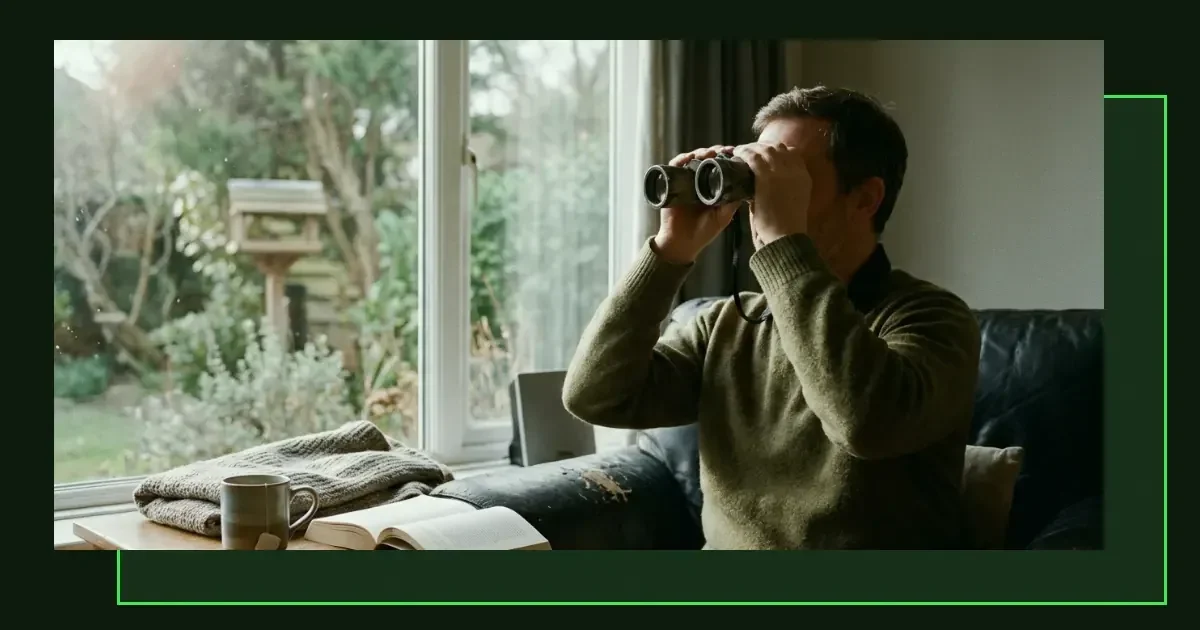
If leaving the house feels difficult, birdwatching works from a window. Put out seed or fat balls and watch what arrives. The repetition of checking the feeder, noting what is there, waiting for the next visitor — it is the same practice, and it still trains attention and patience.
Joining a local group
Some people find that watching birds alongside others steadies them more than watching alone. Local wildlife trusts and RSPB groups run walks and events. Showing up is the only requirement. No one will ask why you are there or what brought you to birdwatching. The shared focus on what is in the hedge or on the water gives you something to talk about that is not yourself.
When birdwatching is not enough
Nature activities support recovery but do not replace the structures that keep you safe. If urges to gamble return, or if birdwatching stops steadying you the way it did, that is a signal to reach out rather than push through alone. Managing urges outdoors covers what to do when cravings hit while you are walking or watching wildlife.
GamCare offers free, confidential support at www.gamcare.org.uk and through the National Gambling Helpline on 0808 8020 133, available around the clock. BeGambleAware provides information and tools at www.begambleaware.org. GamStop at www.gamstop.co.uk lets you block access to licensed gambling sites across Great Britain in one step, free of charge. If you need residential or online treatment, Gordon Moody at www.gordonmoody.org.uk offers programmes designed for people affected by gambling harm. Blocking software such as Gamban (gamban.com, paid subscription) and BetBlocker (betblocker.org, free, works across multiple devices) add another layer of protection if you share a device or want to limit access further.
Gambling is for people aged 18 and over. If you live with someone younger, parental-control software such as Net Nanny or Qustodio can restrict access on shared devices.
Birdwatching is one way to train the attention recovery needs. It works best alongside the limits, breaks, and support that keep you grounded when nature alone is not enough. Building an outdoor daily routine and grounding techniques outdoors offer other ways to use time outside as part of your recovery.
This article is for information only. Whitley Wildlife is not a casino, bookmaker, or organiser of gambling. The content on this site is for people aged 18 and over. If you need confidential support with gambling, BeGambleAware.org is available without charge.
#Grounding techniques #Nature walks
Further reading
Frequently asked questions
How does birdwatching help with gambling urges?
Birdwatching trains you to hold your attention on one thing and wait without forcing a result. Those two skills help when urges arrive: you can notice the urge sooner, stay with the discomfort instead of acting on it, and let it pass without needing it to produce something.
What if I do not know any bird names yet?
You do not need to name them to benefit from watching them. The practice is in the steadying of attention, not in identification. A cheap field guide or a free app will help you learn names over time, but the training happens whether you know what you are looking at or not.
Can birdwatching replace other recovery support?
No. Birdwatching supports recovery but does not replace the limits, breaks, and contact with others that keep you safe. If urges return or intensify, reach out to GamCare, BeGambleAware, or another support service rather than relying on nature activities alone.