Nature journaling for recovery: a quiet way to track what you see and how you feel
 Save
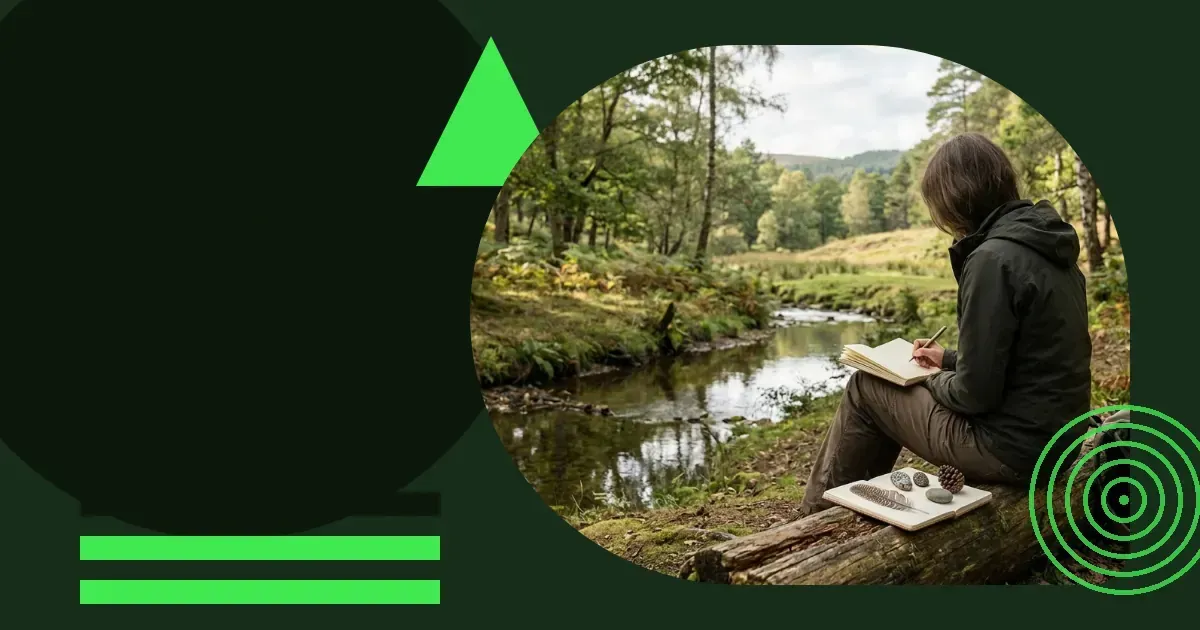
Nature journaling is the practice of recording what you notice outdoors in a notebook you keep with you: the birds overhead, the weather, the shape of a particular tree. In recovery from gambling, it does double work, because it tracks your emotional state at the same time and lets you see how the two influence each other. At Whitley Wildlife we have seen how this quiet daily habit gives people a steady anchor away from the cycle of urges and losses. What follows is a guide to starting your own nature journal, with a structure for each entry, different approaches you can try, and a way to tell whether it is helping.
Nature journaling in recovery
A nature journal is not a diary of your day or a record of your gambling history. It is outdoor reflection writing with a simple purpose: to record what is in front of you right now, with a short note alongside about how you feel in that moment. The practice draws on fieldcraft, the habit of observing your surroundings closely, which walkers and naturalists have used for generations to stay oriented.
For someone rebuilding after gambling harm, the value is in the pairing. You write what you see and what you feel on the same page, and over time patterns emerge that neither record would show alone. A grey afternoon might coincide with low mood every time you note it. A walk by water might line up with the calmest entries in your notebook. The journal makes those links visible.
This is different from journaling about gambling itself. You are not replaying losses or listing what went wrong. You are training your attention outward, towards something steady and real, while still being honest about your inner state.
What you need to begin
You need very little. A small notebook that fits in a pocket, a pen, and a place outdoors where you can sit or stand for a few minutes. That is the whole kit.
The temptation is to buy specialist equipment before you start: a hardback sketchbook, waterproof pens, a field guide to British birds. None of that is necessary. What actually helps:
- A cheap pocket notebook, because you will carry it more often
- A pen or pencil that works in damp weather
- A spot you can return to: a bench, a tree, a stretch of path
If you want to draw rather than write, any pencil will do. The point is not to make art. The point is to look closely enough at something that you can put it on the page, even badly. Looking is the skill; drawing is just a way of proving you did it.
Tracking what you notice outdoors
The first half of a nature journal entry is observation. You record what is around you using whatever senses are available. The goal is specificity. 'Bird singing' is less useful than 'high thin call from the hedge, repeated three times then silence.'
Weather matters more than you might think. A note on temperature, wind and cloud cover gives each entry a frame, and over weeks you start to see how weather and mood move together. Write what is actually there rather than what you expect: a dunnock feeding under a bush is more interesting than 'small brown bird.' The same principle applies if you are birdwatching as a mindfulness practice: the more precisely you identify what is in front of you, the more your attention settles on the present.
Using all your senses
Sight is the default sense. But sound tells you more outdoors: the direction of wind, the presence of animals, the distance of traffic. Smell changes with weather and season. Touch tells you whether bark is rough or smooth, whether the air is damp.
Recording change over time
The richest entries come from revisiting the same spot. A tree that looked bare one month will have buds the next. A path that felt threatening at dusk might feel neutral in morning light. Change is the story your journal tells, and it only appears when you return.
Tracking how you feel
After recording what is outdoors, you write one or two lines about your internal state. This is not therapy. It is an honest note: calm, restless, flat, tense, craving.
The discipline is to name without judging. 'I feel anxious' is a complete entry. 'I feel anxious and I hate that I feel anxious' is two things, and the second gets in the way. Grounding techniques in nature for anxiety work on the same principle: the act of naming what you sense outdoors often makes the emotional note easier to write, because you have already slowed down.
Noticing urges and triggers
If a gambling urge arrives while you are journaling, write that down too. Note what was happening just before: where you were, what you saw, what time of day. The journal is not a confessional. It is a record of conditions, and over time you may notice that certain places, weathers or times precede urges.
Linking environment and emotion
The heart of nature journaling for recovery is the link between the two halves. On their own, a record of weather and a record of mood are interesting but separate. Together, on the same page, they start to tell a story.
You might notice that your calmest entries come on mornings near water. You might find that restlessness shows up on bright windy days when you slept badly. The link is not always direct, and it does not need to be. What matters is that you are building a picture of your own patterns: the conditions under which you feel steady and the ones under which you do not.
The link between what you see and how you feel is the whole point of the practice. Without it, you have a nature diary and a mood diary side by side, not speaking to each other.
A mood tracker tells you how you felt. A nature journal tells you what was around you when you felt that way, and that is the information you need to build a life that supports recovery rather than testing it. If you want to know whether this is working, the signs that nature activities are helping are things you can notice yourself.
A structure for your first entries
A blank page is the main obstacle. A fixed structure removes it. The following sequence works for a first entry and for every entry after:
- Choose a small notebook and pen you can carry in a pocket
- Sit or stand somewhere outdoors where you feel settled
- Write the date, location and weather at the top of the page
- List several things you can see, hear or feel right now
- Below that, write one line about how you feel at this moment
- Note any link between what you noticed outdoors and how you feel inside
The last step is the one that matters most and the one people skip. The link does not have to be profound. 'Saw a heron, felt less tense' is enough. The point is to train the habit of looking for connection between the outer and the inner, because that connection is what makes the journal a recovery tool rather than a hobby.
Different ways to keep your journal
There is no single correct way to keep a nature journal. Some people write. Some people draw. Some people work in bullet points. In our view, the best approach is the one you will actually do.
Journaling for wellbeing works best when it is simple enough to maintain. The table below compares four common approaches. None requires training or specialist equipment.
| Approach | What it focuses on | What it gives you |
|---|---|---|
| Written notes | Words describing what you see and how you feel | The fastest to start; needs only a pen |
| Quick sketches | Simple drawings of what is in front of you | Forces closer looking than words alone |
| Weather and mood log | Daily weather alongside a one-word mood note | Shows patterns over weeks at a glance |
| Single-spot return | The same place visited repeatedly | Tracks change in the place and in yourself |
You can switch between approaches depending on the day. A restless mind might settle better with drawing than writing. A tired evening might produce only a weather note and a single word for mood. Both are valid entries.
Start this week
You do not need to wait for the right notebook, the right weather or the right frame of mind. The journal begins the first time you step outside with a pen.
- Pick a notebook you already own and put it by your door
- Walk to the nearest green space and sit for a few minutes
- Write the date, one thing you can see and one word for how you feel
- Do the same thing tomorrow at the same time
Getting help with gambling
If gambling is affecting your life or someone else's, support is available. The organisations below offer free help to people in the UK.
- GamCare – gamcare.org.uk. National Gambling Helpline: 0808 8020 133 (free, 24/7)
- BeGambleAware – begambleaware.org
- GamStop – gamstop.co.uk (free self-exclusion from gambling sites licensed in Great Britain)
Gambling sites licensed by the Gambling Commission must offer tools including deposit limits, time-outs and self-exclusion. GamStop lets you self-exclude from all licensed sites at once. Online gambling is for people aged 18 and over (18+).
This article is for general information only. Whitley Wildlife is an independent information site and does not sell any goods or services.
#Mindfulness #Anxiety #Grounding techniques
Download PDF: Your first week of nature journaling PDF, 27 KB
Further reading
Frequently asked questions
If I only have a few minutes outdoors, is a nature journal entry still worth writing?
Yes. A single line about the weather and one word for your mood is a complete entry. The value is in the habit of noticing, not in the length of what you write.
What should I write in an outdoor reflection journal on days when nothing seems noteworthy?
Write exactly what is in front of you, however ordinary. Grey sky, bare branches, the sound of traffic are the details that become interesting when you return to them weeks later. The journal is not for remarkable days only.
How does journaling for wellbeing in recovery differ from keeping an ordinary diary?
An ordinary diary records what happened. A recovery journal records what you noticed and how you felt at the same time, so the link between your surroundings and your emotional state becomes visible. That link is what makes it a tool for recovery rather than a record of events.